
Introduction
Many contractors have noticed a new type of Google advertisement appearing at the very top of search results.
These are called Local Service Ads, also known as LSAs.
Unlike traditional Google Ads, Local Service Ads focus heavily on phone calls, reviews, trust signals, and local visibility.
For many contractors, LSAs can be an effective source of leads. However, like any marketing channel, results can vary depending on your market, competition, reviews, and follow-up process.
In this guide, we'll explain how Local Service Ads work, their advantages and disadvantages, and whether they make sense for your business.
What Are Local Service Ads?
Local Service Ads are a type of Google advertisement designed specifically for local service businesses.
They often appear above traditional Google Ads and organic search results.
When homeowners search for services such as:
- Roofing Contractors Near Me
- Bathroom Remodeling Contractor
- Window Replacement Company
- Local Painter
- Flooring Contractor
Their goal is simple:
Connect homeowners with local businesses that provide the services they need.
How Local Service Ads Work
Unlike traditional Google Ads, which typically charge businesses when someone clicks on an advertisement, Local Service Ads generally operate on a pay-per-lead model.
Contractors are usually charged when a homeowner contacts their business through the platform.
This can make LSAs attractive because businesses are often paying for actual inquiries rather than website visits.
However, not every lead is equal.
Some homeowners are ready to hire immediately, while others may simply be gathering information or contacting multiple contractors at the same time.
This is why lead quality remains one of the most important factors when evaluating any marketing channel.
Compared to Google Ads, where campaigns can be continuously optimized using keyword data, conversion tracking, call tracking, and landing page performance, Local Service Ads provide significantly less control over the information available to advertisers.
While LSAs can generate quality leads, the limited access to data can make it more difficult to identify exactly what is driving results and where improvements can be made. This is one reason many contractors continue to invest heavily in Google Ads, where lead quality can often be refined and optimized over time.
What Is Google Guaranteed?
One of the most recognizable features of Local Service Ads is the Google Guaranteed badge.
To qualify, businesses may need to complete various verification steps depending on their industry and location.
These can include:
- License verification
- Insurance verification
- Business checks
- Background checks where applicable
For homeowners, the badge can help build trust before they contact a contractor.
In many cases, this additional trust can increase the likelihood of receiving calls and inquiries.
However, it's worth noting that Google Ads advertisers can also complete Google's advertiser verification process. In many cases, businesses simply need to submit the required documents and wait for Google's review process to be completed.
While trust signals are important, success ultimately depends on factors such as reviews, lead quality, follow-up, website experience, and overall marketing performance rather than a badge alone.
Benefits of Local Service Ads
High Visibility
One of the biggest advantages of LSAs is visibility.
Because they often appear above traditional advertisements and search results, they can place your business directly in front of homeowners actively searching for your services.
Qualified Homeowners
Many people using Local Service Ads are actively looking for a contractor.
This often results in highly motivated leads who are further along in the buying process.
Strong Trust Signals
Reviews and the Google Guaranteed badge can help build credibility.
Many homeowners feel more comfortable contacting businesses that have strong reviews and verified profiles.
Pay Per Lead
Unlike traditional Google Ads, which charge per click, Local Service Ads typically charge for leads.
This can sometimes reduce wasted advertising spend.
Potential Drawbacks
Less Control
One downside of Local Service Ads is that contractors generally have less control over targeting compared to Google Ads.
You don't have the same level of control over keywords, bidding strategies, and campaign optimization.
Lead Quality Can Vary
Not every lead will be a perfect fit.
Some inquiries may be outside your service area, outside your budget range, or simply shopping around.
Competition
As more contractors adopt Local Service Ads, competition continues to increase in many markets.
Businesses with stronger reviews often have an advantage.
Shared Leads
In some situations, homeowners may contact multiple contractors through the platform.
This is one reason response time is so important. In many cases, the contractor who responds first has a greater chance of securing the estimate.
Fast response times become extremely important.
Why Reviews Matter So Much
Reviews play a major role in Local Service Ads performance.
Many homeowners compare contractors before making a decision.
A business with a large number of positive reviews often creates more trust than one with only a handful of reviews.
This is why it's important to consistently request reviews from satisfied customers.
Many contractors automate the review process so customers receive a simple reminder after a project is completed.
A single review may not seem significant, but over time those reviews can become one of your most valuable marketing assets.
Local Service Ads vs Google Ads
Both platforms can generate leads, but they operate differently.
Local Service Ads
- Pay per lead
- Strong focus on reviews
- High visibility
- Easier to manage
- Less control
Google Ads
- Pay per click
- Greater targeting control
- More optimization opportunities
- Better keyword visibility
- More campaign flexibility
📊 Click the diagram to view a larger version.
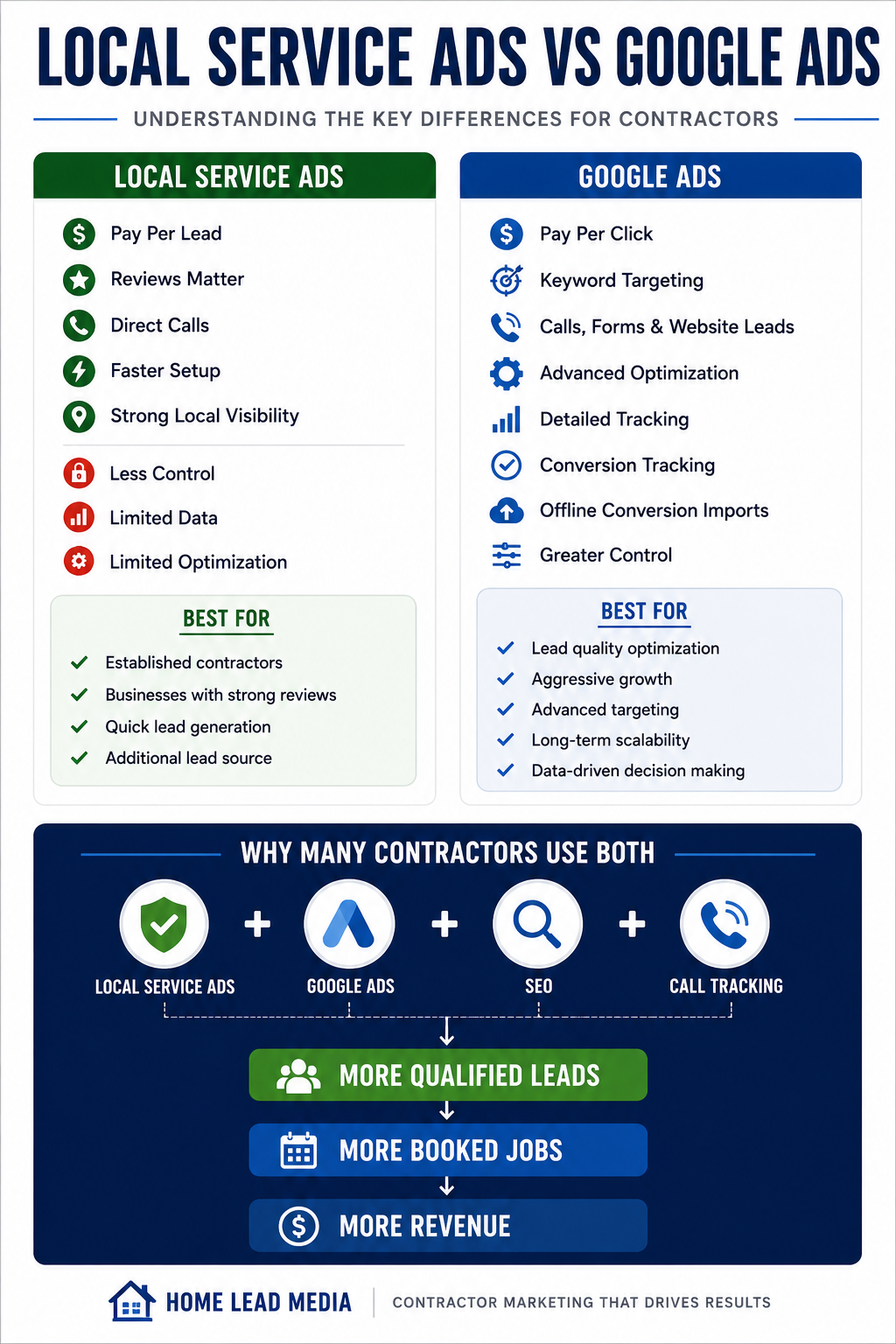
For many contractors, the best strategy is not choosing one or the other.
It's often using both together.
Why Tracking Still Matters
One of the biggest misconceptions about Local Service Ads is that every lead is automatically a good lead.
This isn't always true.
A lead only becomes valuable when it turns into revenue.
This is why tracking remains extremely important.
Contractors should track:
- Calls
- Form submissions
- Booked estimates
- Closed jobs
Without tracking, it's difficult to know which leads are generating actual business results.
Many contractors already invest significant amounts of money into advertising.
Why not make sure you're getting the best possible return on that investment?
A proper tracking system helps identify which leads are producing revenue and which leads may be wasting time and budget.
Tracking can also help contractors better understand the quality of the leads generated through Local Service Ads. However, compared to Google Ads, the ability to optimize campaigns is often more limited because advertisers have less control over the available data and targeting options.
With Google Ads, businesses can track conversions, upload offline conversion data, measure booked jobs, and continuously optimize campaigns based on real outcomes. This additional data can help improve lead quality over time and allow Google's algorithms to better identify the types of customers most likely to become paying clients.
Local Service Ads and SEO
Many contractors think they must choose between Local Service Ads and SEO.
In reality, these marketing channels often work very well together.
SEO helps improve long-term visibility and generates organic traffic.
Local Service Ads can help generate leads much faster.
Together they create multiple opportunities for homeowners to discover your business.
The more places your company appears during a homeowner's search journey, the greater the opportunity to earn their business.
Related Insight
If you haven't read it yet, check out our guide: Contractor SEO: How to Rank Higher and Generate More Leads . Discover how SEO helps contractors increase visibility, attract qualified homeowners, and generate long-term organic leads.
When Local Service Ads Make Sense
Local Service Ads are often a good fit for:
- Established contractors
- Businesses with strong reviews
- Companies looking for more calls quickly
- Contractors wanting additional lead sources
When Google Ads May Be Better
Google Ads may be a stronger option when:
- You need more targeting control
- You offer specialized services
- You want advanced optimization options
- You are focused on aggressive growth
Many contractors eventually use both platforms together.
Related Insight
If you haven't read it yet, check out our guide: Google Ads for Contractors: How to Generate More Qualified Leads . Learn how Google Ads can help contractors appear in front of homeowners actively searching for their services and generate qualified leads faster.
Final Thoughts
Local Service Ads can be an excellent lead generation tool for contractors.
However, success depends on more than simply turning the platform on.
Reviews, follow-up speed, lead quality, tracking, and ongoing optimization all play important roles.
The most successful contractors often combine Local Service Ads, Google Ads, SEO, and strong tracking systems to create a predictable flow of qualified leads.
Rather than relying on a single source of leads, they build multiple marketing channels that work together to support long-term growth.
The goal is not simply to generate more leads. The goal is to generate better leads and continuously improve marketing performance over time.
Need More Contractor Leads?
Book a free consultation and we'll review your current lead generation strategy, website performance, tracking systems, and opportunities to generate more qualified leads for your business.
📅 Book Free Consultation