
Many contractors invest in websites that look professional but fail to generate leads.
A website should do more than showcase your business. It should help turn visitors into phone calls, estimate requests, and booked projects.
The reality is that homeowners often compare multiple contractors before making a decision. If your website doesn't build trust, clearly explain your services, and make it easy to contact you, potential customers may move on to a competitor.
In this guide, we'll explain what makes a high-converting contractor website and how the right website can help generate more qualified leads.
Why Contractor Websites Matter
For many homeowners, your website creates the first impression of your business.
Before making a phone call or requesting an estimate, most people will visit your website to learn more about your company.
They're looking for answers to questions such as:
- What services do you offer?
- Do you serve my area?
- Can I trust your company?
- How do I contact you?
A well-designed website helps answer these questions quickly while encouraging homeowners to take the next step.
Even small details matter. If homeowners can't quickly confirm that you serve their area, they may leave and contact a competitor whose website clearly communicates where they operate.
What Is a High-Converting Website?
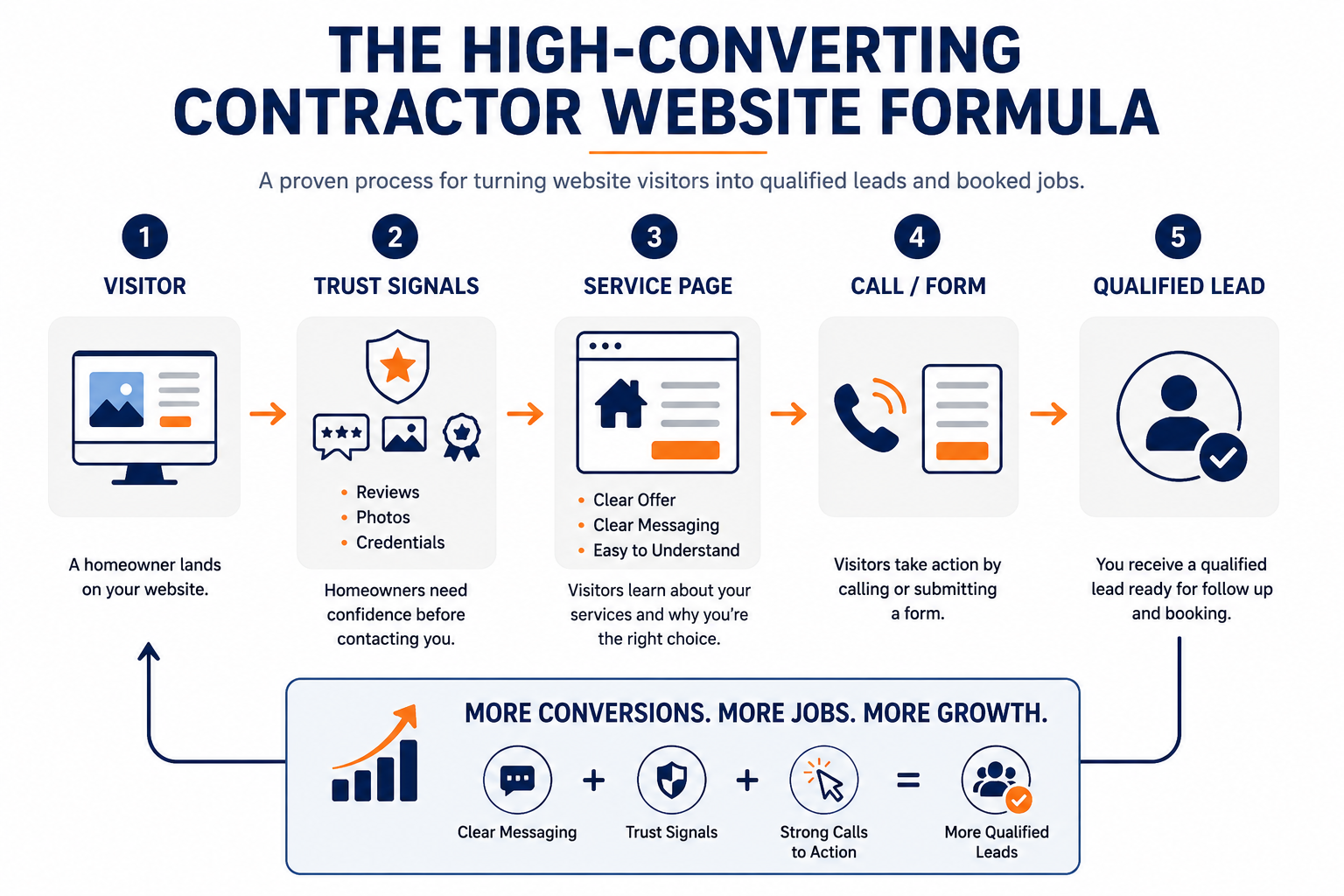
A high-converting website is designed to turn visitors into leads.
The process often looks like this:
Visitor
↓
Trust
↓
Contact
↓
Lead
The goal is not simply to attract traffic. The goal is to convert that traffic into phone calls, form submissions, and estimate requests.
In many cases, keeping things simple produces better results. Homeowners usually want quick answers, clear information, and an easy way to contact your business. Too many distractions, unnecessary pages, or confusing layouts can cause visitors to leave before taking action.
A clean website that clearly explains your services and guides visitors toward a phone call or estimate request often has a much better chance of converting traffic into qualified leads.
📊 Click the diagram to enlarge it. For the best experience on mobile, turn your phone sideways.
Clear Service Messaging
One of the biggest mistakes contractors make is assuming visitors already understand what they do.
When someone lands on your website, they should immediately know:
- What services you offer
- Who you help
- Where you operate
- How to contact you
Clear messaging helps reduce confusion and encourages visitors to stay on your website longer.
The easier it is for homeowners to understand your business, the more likely they are to contact you.
We often see excellent contractors struggle to generate the number of leads they deserve simply because their website makes it difficult for homeowners to find information or take action.
In some cases, a competitor with fewer reviews, less experience, or lower-quality work can generate more leads simply because they have a better website experience. When homeowners can quickly understand the services offered, view trust signals, and easily request an estimate, they're often more likely to choose that company.
Strong Calls to Action
Every contractor website should make it obvious what visitors should do next.
Examples include:
- Call Now
- Request a Free Estimate
- Book a Consultation
- Schedule an Appointment
Many websites lose potential leads simply because there is no clear next step.
A strong call to action helps guide visitors toward becoming customers.
One of the most common mistakes we see on contractor websites is the lack of a clear call to action, especially on mobile devices. Since many homeowners browse and compare contractors on their phones, it's important to make contacting your business as simple as possible.
Whether someone is viewing your website on a desktop computer or a mobile device, they should always have an easy way to call, request an estimate, or submit a contact form. Clear and visible call-to-action buttons can significantly increase the chances of turning a visitor into a lead.
Customer Reviews Build Trust
Trust is one of the most important factors in lead generation.
Homeowners often spend thousands or even tens of thousands of dollars on home improvement projects. Before contacting a contractor, many people want reassurance that they're making the right choice.
Displaying reviews throughout your website can help build credibility and increase conversion rates.
Positive customer experiences provide social proof that your company delivers quality work.
Once a lead turns into a completed project, it's important to continue the process by asking for a review. Many satisfied customers are happy to leave positive feedback, but they often need a simple reminder.
This is why many contractors use automated follow-up systems to request reviews after a project is completed. A quick text message or email reminder can significantly increase the number of reviews your business receives.
Those reviews can then help attract future customers, creating a cycle where one successful project leads to more trust, more visibility, and ultimately more leads over time.
Showcase Project Photos
Project photos help homeowners visualize the quality of your work.
Before-and-after photos can be especially effective because they clearly demonstrate results.
Many homeowners want proof before reaching out to a contractor.
Photos help build confidence while making your services feel more tangible and trustworthy.
Many homeowners compare multiple contractors before making a decision. Strong project photos can often be the difference between someone contacting your company or continuing their search elsewhere.
Mobile-Friendly Design
Most homeowners browse contractor websites on mobile devices.
Mobile devices now account for more than 60% of global website traffic, making mobile-friendly design one of the most important factors in lead generation and user experience. If homeowners struggle to navigate your website on their phone, they're more likely to leave and contact a competitor instead.
If your website is difficult to navigate on a phone, loads slowly, or requires excessive scrolling, visitors may leave before contacting you.
This is why mobile optimization is so important.
A mobile-friendly website makes it easy for visitors to:
- Call your business
- Submit a form
- View project photos
- Read reviews
- Learn about your services
The easier the experience, the more likely visitors are to become leads.
Fast Loading Speed
Website speed plays a major role in user experience.
Many homeowners will leave a website if pages take too long to load.
Slow websites can increase bounce rates and reduce conversions.
Fast-loading websites provide a better experience for users while also supporting SEO performance.
Small improvements in speed can often lead to meaningful improvements in lead generation.
This is why website performance should never be overlooked. If your website loads slowly, some visitors may leave before they even see your services or contact information.
Make sure your web developer uses reliable, high-performance hosting and follows best practices for website speed optimization. If you're working with a marketing agency, ask them how they handle website performance and page speed.
Faster websites provide a better user experience, improve conversion rates, and help ensure potential customers stay on your site long enough to take action.
Why Simplicity Often Wins
Many contractor websites try to include too much information.
Too many menus, pop-ups, animations, or distractions can overwhelm visitors.
The highest-converting websites are often the simplest.
Visitors should quickly find:
- Services
- Service areas
- Reviews
- Project photos
- Contact information
A clean layout helps guide visitors toward taking action.
Common Contractor Website Mistakes
No Clear Call to Action
Visitors should never wonder how to contact your business.
Poor Mobile Experience
Many contractor websites look fine on desktop but perform poorly on mobile devices.
Slow Loading Pages
Every extra second of load time can reduce conversions.
Generic Content
Homeowners want information specific to their project and location.
Lack of Trust Signals
Reviews, testimonials, project photos, and certifications help build confidence.
Why Landing Pages Matter
Many contractors send all traffic to their homepage.
However, dedicated landing pages often perform much better.
For example, a homeowner searching for roof replacement services wants information about roof replacement.
A dedicated roofing landing page typically converts better than a general homepage because it directly addresses the visitor's needs.
This is why choosing the right team to build your landing pages is so important. Landing pages are often the final step before a homeowner decides whether to contact your business or move on to a competitor.
A page may look professional, but if it isn't designed with marketing and conversions in mind, it can still lose potential customers. The best landing pages combine clear messaging, trust signals, strong calls to action, and a simple user experience that encourages visitors to take the next step.
Since landing pages often play a direct role in turning website traffic into leads, investing in pages that are built for conversion can have a significant impact on overall marketing performance.
The process often looks like this:
Google Ad
↓
Roofing Landing Page
↓
Estimate Request
↓
Lead
When the page closely matches the homeowner's search intent, conversion rates often improve significantly.
Why Tracking Matters
A high-converting website should do more than generate leads.
It should also help you understand where those leads are coming from.
Tracking tools can help measure:
- Phone calls
- Form submissions
- Appointment requests
- Landing page performance
Without tracking, it's difficult to know what's working and what needs improvement.
This is why many successful contractor marketing campaigns rely heavily on data and ongoing optimization.
The more information you have, the easier it becomes to improve performance over time.
Websites, SEO, and Google Ads Work Together
Many contractors view websites, SEO, and Google Ads as separate strategies.
In reality, they work best together.
- SEO helps homeowners find your website organically.
- Google Ads helps generate immediate traffic.
- Your website converts those visitors into leads.
If any one of these elements is weak, overall performance can suffer.
The strongest lead generation systems typically combine:
- High-converting websites
- SEO
- Google Ads
- Reviews
- Call tracking
Together, these strategies help create a predictable flow of qualified homeowner inquiries.
Final Thoughts
A contractor website should do more than look professional.
It should help generate leads, build trust, and make it easy for homeowners to contact your business.
The best contractor websites focus on simplicity, user experience, trust, and conversion.
Small improvements in messaging, design, speed, and calls to action can often produce significant improvements in lead generation over time.
Instead of treating your website as an online brochure, think of it as one of the most important lead generation tools your business owns.
Need More Contractor Leads?
Book a free consultation and we'll review your website, lead generation strategy, conversion opportunities, and areas where you may be losing potential customers.
📅 Book Free Consultation